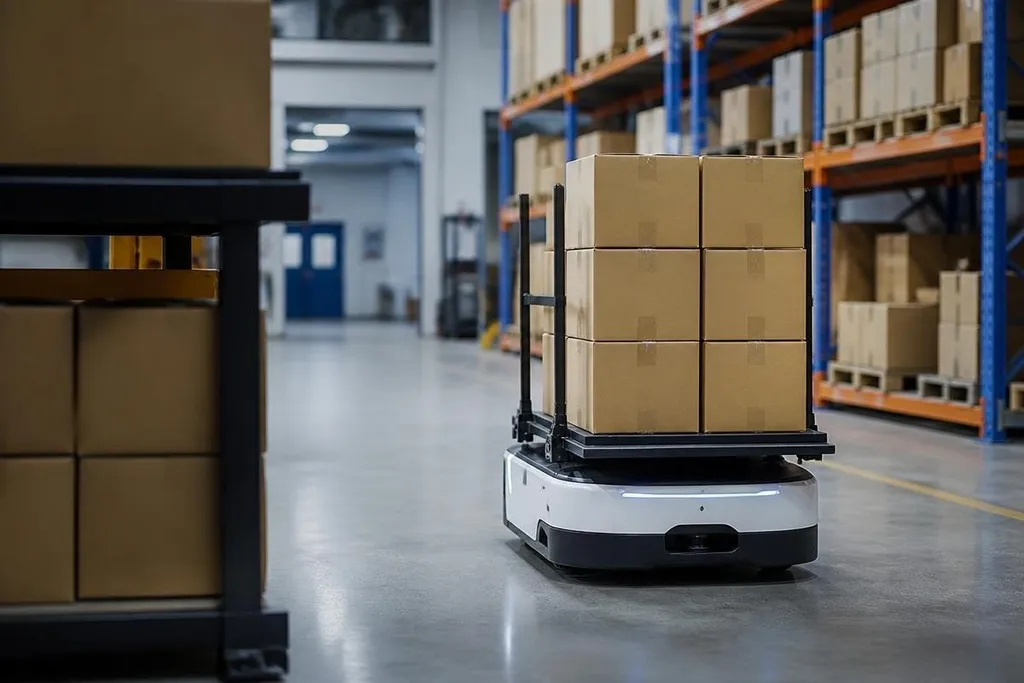
A robot fits a job best when the work repeats, the space stays controlled, and success can be checked with clear rules.
That points to tasks such as moving boxes, checking parts, cleaning floors, and carrying items through a building rather than work built around trust, judgment, or changing conversations.
Quick read
- Robots fit repeatable physical tasks with fixed steps.
- People remain needed when work depends on care, judgment, or changing conditions.
- The best job question is: which task can a robot do, and which task stays with the worker?
Repetition makes a job easier to automate
A robot needs a task it can sense, plan, and repeat. A box moving from a conveyor to a pallet gives it a clear object, a known location, and a result that can be checked.
That pattern appears in warehouse picking, factory assembly, packaging, sorting, and machine tending. The worker may still load supplies, handle exceptions, check quality, or change the setup between product runs.
The job does not vanish as soon as a robot takes one task. It changes shape. A person may spend less time lifting or reaching and more time checking the robot, clearing blocked paths, or fixing a failed handoff.
Controlled spaces give robots an easier job
Robots work best when the floor, lighting, objects, and routes change very little. A factory cell with marked zones is easier to manage than a busy public space with loose objects and people moving in many directions.
That is why fixed industrial arms have a clear path into work such as welding, painting, screwdriving, and palletizing. Mobile robots can fit work inside warehouses, hospitals, hotels, or offices when doors, lifts, and routes have been prepared for them.
The physical setting still matters. A mobile robot may move well on a flat floor, then stop when a cable crosses its route or a door fails to open. Someone must handle those cases, and that person needs time, training, and safe access.
Jobs with people at the center need a different design
Work that depends on conversation, care, or judgment is harder to hand over to a robot. A nurse deciding how a patient feels, a teacher responding to a child, or a technician explaining a fault faces conditions that can change from one moment to the next.
Robots can still help around those jobs. A system may carry supplies, lift a heavy load, scan an area, or record measurements while a person makes the decision that affects another person.
This division keeps the robot on a task with a clear finish. It also gives the worker control when the machine meets something outside its training or sensor range.
That control matters most when a job mixes repeatable steps with human judgment. Robot24.com workplace robotics coverage can add named machines and work sites to the comparison before the next section looks at which tasks fit robots in practice.
The task matters more than the job title
A single job can contain tasks that suit robots and tasks that do not. A warehouse worker may move a tote along a fixed route, then inspect damaged goods. A maintenance technician may use a robot for an inspection, then decide what repair the site needs.
This is a better way to judge automation than asking if a whole occupation is safe or at risk. Break the job into actions, then check the conditions around each one:
- Repeatable motion: Does the task follow the same steps most of the time?
- Clear objects: Can sensors identify the item, its position, and its condition?
- Known surroundings: Do floors, routes, lighting, and work areas stay steady?
- Measurable output: Can someone check the result with a count, image, weight, or pass-fail test?
- Safe handoff: Can a person take over when the robot stops or meets an unknown object?
- Useful cost: Does the robot save enough labor or reduce enough strain to cover purchase, setup, service, and downtime?
A practical way to judge your own work
Start with one task, not the whole job. Write down the steps, the objects involved, the points where the work fails, and the moments when a person must make a choice. Then mark the tasks that repeat in the same place with the same tools.
I'd start with work that is tiring and easy to check, because a small trial can show its limits without putting the whole operation at risk. Keep a person close during the trial, record every stop, and count the time spent preparing and correcting the robot.
The jobs most likely to work with robots are built around clear tasks, not vague promises. The useful question for any workplace is what the robot can repeat safely today, and what the worker still needs to decide.